Expert Answers

Is It Better to Hire an Agency or an In-House Marketing Team?
Expert Answers

Is It Better to Hire an Agency or an In-House Marketing Team?

Is It Better to Hire an Agency or an In-House Marketing Team? A founder I worked with last year had already hired two in-house marketers before he ever called us. Six months in, he was paying two salaries, still handling PPC himself on weekends, and his content calendar was three weeks behind. He wasn’t a bad hirer. He’d just made the decision too early, before his business actually needed what an internal team is built to provide. This is one of the most common crossroads I see growing brands hit, and most founders treat it as a simple either-or choice. It rarely is. Let me walk you through how I actually think about this decision, because the right answer depends far more on your stage of growth than most people realise. The Real Cost Difference Nobody Explains Clearly The most obvious difference between the two models is how your money actually gets spent, and it’s bigger than most founders expect. Building an in-house team means fixed costs that don’t move, no matter how your revenue does that month. A performance marketer in India typically costs somewhere in the range of ₹6 to ₹12 lakhs a year depending on experience. An SEO or content specialist sits in a similar range. A designer or video editor adds another chunk. Add software subscriptions, recruitment costs, and basic overhead, and a modest three-person internal marketing setup can easily cost ₹25 to ₹40 lakhs a year, before a single rupee goes toward actual ad spend. And if revenue dips that quarter, those salaries don’t dip with it. A digital marketing agency works on a completely different cost structure. You pay a monthly retainer that’s typically a fraction of what a full internal department costs, and that retainer buys you access to a whole team – strategists, media buyers, designers, data specialists – without carrying any of them as a fixed liability on your books. One Generalist vs. an Entire Team of Specialists Marketing today isn’t one skill. It’s data tracking, video production, copywriting, platform-specific ad buying, and technical SEO, all running at once. That’s a lot to expect from one or two people. When a growing business hires its first internal marketer, they’re almost always forced to hire a generalist – someone who “knows social media and can also handle a blog.” That person is rarely deep in any single area, and it’s not their fault. Nobody can be genuinely excellent at six different disciplines simultaneously. Your growth eventually hits a ceiling, not because your marketer isn’t trying, but because they physically can’t stretch that far. A proper digital marketing agency brings a full team instead of one stretched person. A dedicated media buyer runs your ad spend. A technical SEO specialist audits your website. A creative director handles your video hooks. They’re all working on your account together, not one person juggling all of it alone. Where In-House Teams Genuinely Win Agencies win on cost and breadth of skill, but internal teams have one real advantage – proximity. Someone sitting inside your company every day absorbs your brand, your product, and your customer feedback in a way that’s hard to replicate from outside. They can walk over to the product team and get an answer in five minutes. They know your customers because they’re talking to your support team over lunch. An agency, even a great one, is managing other clients alongside yours. They build strong communication systems to stay close to your business, but they’ll never have that same 24/7 immersion an internal employee has by default. You have to actively feed them context, product updates, and customer insight, rather than assuming they’ll pick it up by osmosis. The Hybrid Model Most Growing Brands End Up Choosing You don’t actually have to pick one side completely, and honestly, most businesses that scale well don’t. The model I see working best combines both. Keep one strong person in-house as your brand quarterback – a marketing lead who deeply understands your product, sits close to daily operations, and acts as the bridge between your business and whoever’s executing outside. Then bring in a digital marketing agency to handle the heavy execution – paid media, technical SEO, video production, data infrastructure – the parts that genuinely benefit from a full specialist team rather than one generalist trying to cover everything. This gives you someone who knows your business inside and out, plugged into a team that can actually execute at the level modern marketing requires. Matching the Model to Where You Actually Are If you’re an early-stage business still finding product-market fit, building an expensive in-house team before you have that certainty is one of the fastest ways to burn through cash you’ll need later. Working with an agile agency to build initial traction and acquisition loops usually makes far more sense at this stage, since you’re not locked into fixed salaries while you’re still figuring things out. If you’re a larger, established brand with constant product launches and a genuinely large operational footprint, an in-house core team starts to earn its place, usually still backed by an agency partner for the specialised, heavy-lifting work that’s hard to build fully in-house. There’s no universally right answer here. There’s only the right answer for your current stage, your budget, and how much of this work genuinely needs someone sitting inside your walls versus a specialist team executing from outside them. Clients Also Ask Is it cheaper to hire a digital marketing agency or build an in-house team in India? An agency is almost always cheaper in the short term, since you’re paying a single monthly retainer instead of multiple full-time salaries, benefits, and software costs. An in-house team can become more cost-efficient at a larger scale, but usually only once your marketing needs are big and consistent enough to justify several full-time specialists. How do I know if my business is ready for an in-house marketing team? A good sign is when your marketing needs have

Google Ads vs Meta Ads Where Should You Spend First (Straxcel Business Solutions)
Expert Answers

Google Ads vs Meta Ads : Where Should You Spend First?

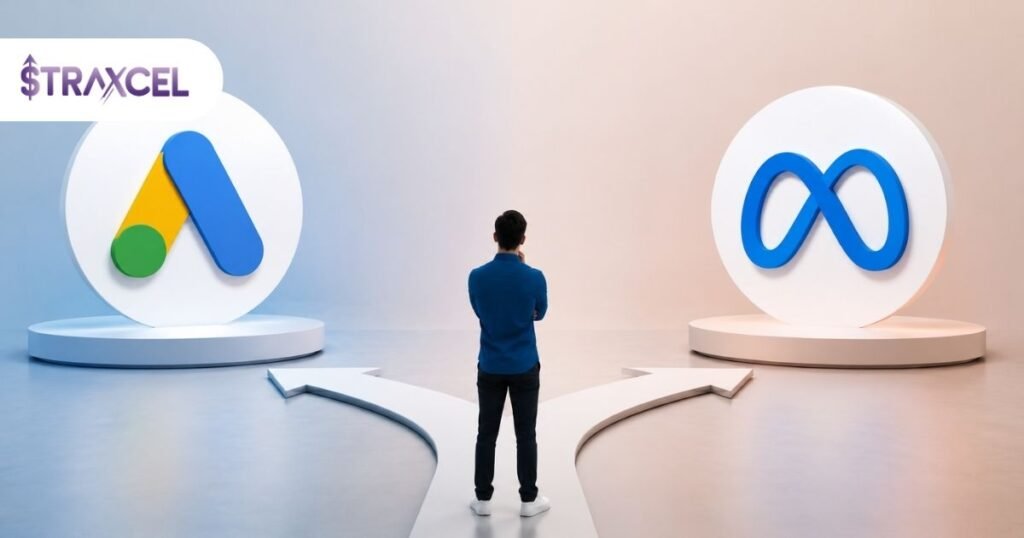
Google Ads vs Meta Ads : Where Should You Spend First? Almost every founder I work with asks me some version of the same question in our first call – “Google or Meta, where should I put my first rupee?” It’s a fair question, and it’s also the wrong one to lead with, because the honest answer is neither platform is universally better. They work on completely different logic, and picking the right one first depends entirely on what you’re selling and how people actually go about buying it. Let me walk you through how I actually think about this decision, because once you understand the difference in how these two platforms work, the choice usually becomes obvious. Two Completely Different Kinds of Attention The easiest way to understand this is to think about what someone is doing on each platform in the moment your ad reaches them. On Google, someone is actively searching. They’ve typed “emergency plumber near me” or “best CRM software for small business” because they already have a problem and they’re looking for a solution right now. Their wallet is basically already out. Google Ads doesn’t create that desire, it just puts you in front of it at the exact right second. That’s why this is called capturing demand. On Meta, nobody opened Instagram thinking “I really need to buy new software today.” They’re there to see friends, watch reels, and pass time. Your ad has to interrupt that scroll, catch attention in under three seconds, and convince someone of a need they may not have even known they had. Meta doesn’t capture existing demand, it creates new demand. That distinction changes everything about how you should use each platform. When Google Ads Should Get Your Budget First I usually tell clients to lead with a Google ads agency approach first if their business fits a few clear patterns. If you offer something urgent or highly specific – a repair service, a medical clinic, specialised B2B software – people don’t discover that kind of thing scrolling Instagram. They search for it the moment they need it, out of necessity. The same goes for competitive, well-known product categories where buyers actively compare prices, like electronics or office furniture. Google Shopping puts you right next to your competitors at the exact moment someone’s deciding who to buy from. And if a quick check of Google Keyword Planner shows thousands of people already searching for your exact product or service every month in India, that’s demand sitting there waiting to be captured. It makes sense to go after that low-hanging fruit before spending money trying to build brand awareness from scratch on social media. When Meta Ads Should Get Your Budget First On the flip side, I push clients toward Meta first when the business leans on a different set of characteristics. If you’ve built something genuinely new that people don’t already know they need, nobody is searching for it on Google yet. You have to show them how it works and why it matters, and video is far better at that than a search result ever could be. This is exactly why visually driven categories – fashion, beauty, lifestyle products – tend to do so well through a Meta or Facebook ads agency approach, because the format lets you tell an emotional story in seconds. The same logic applies to products with broad appeal rather than a narrow, specific need – fitness gear, home organisation products, gifting items. Meta’s targeting is genuinely strong at finding people based on long-term interests and behaviour, not just a search term they typed once. And lower-priced products that people buy on impulse tend to convert well here too, because a scroll-stopping video ad can trigger a purchase decision in the moment, without the buyer needing to actively search for anything first. The Trap Hiding Inside Each Platform Both platforms have a failure mode I see founders fall into constantly, and it’s worth knowing before you commit budget to either. On Google, the risk is cost. Because search traffic has such high intent, competitive keywords get genuinely expensive. In categories like legal services, insurance, or enterprise software, a single click can cost several hundred rupees. If your landing page isn’t built to actually convert that visitor once they land, you can burn through your entire monthly budget in days without generating a single real lead. On Meta, the risk is creative fatigue. A strong video ad might perform brilliantly for two or three weeks, and then your audience simply gets tired of seeing it. Once that happens, performance drops and your cost per lead climbs, sometimes fast. Winning on Meta over time requires a steady pipeline of new hooks, new visuals, and new angles, not one great ad running on repeat for months. How These Two Actually Work Together Here’s what most articles on this topic skip entirely – you shouldn’t be picking one platform forever. You’re picking where to start, and the smartest brands eventually run both, working together. The sequence I generally recommend to growing businesses looks like this. Start with Google Search and brand protection campaigns first, so that when someone hears about you or searches your exact business name, you’re the one showing up at the top, not a competitor. Once that foundation is secure, bring in Meta to build broader awareness, tell your brand’s story properly, and pull in fresh traffic from people who’ve never encountered you before. Then connect the two – when someone clicks your Meta ad but doesn’t buy right away, retarget them with a Google search ad or a short video the next time they’re actively looking, so you’re catching that same person from two different directions. Making the Actual Decision Stop trying to figure this out from generic comparisons online. Look at your actual product, how your customers genuinely shop for it, and what your margins can realistically support. If people are already searching for what you sell, start with Google Ads

What Should You Look for in Digital Marketing Agencies (Straxcel Business Solutions)
Expert Answers

What Should You Look For in Digital Marketing Agencies in India?

What Should You Look For in Digital Marketing Agencies in India A founder called me last year, three months into a contract with a digital marketing agency in Delhi, and he was frustrated. He’d been promised the “number one spot on Google” during the sales pitch. Three months in, rankings hadn’t moved, nobody could tell him where his ad money had actually gone, and his main point of contact had changed twice without anyone telling him why. He wasn’t a careless buyer either. He’d checked their website, read a few reviews, and liked their pitch deck. The problem wasn’t that he didn’t do research. The problem is that most research people do when picking a digital marketing agency is aimed at the wrong things. I’ve sat on both sides of this table. I’ve pitched for accounts, and I’ve also been brought in to clean up after agencies that looked great on paper and delivered almost nothing. So here’s what I actually tell business owners to look for, based on what separates the agencies that deliver from the ones that just talk well. Everyone Sounds the Same on the Website Every digital marketing company will call itself “data-driven” and “ROI-focused.” Every single one. These words have become so overused they don’t mean anything anymore. If an agency’s homepage is your main basis for deciding, you’re choosing based on copywriting, not capability. What actually separates a good digital marketing agency from a mediocre one shows up in five places, and none of them are the homepage. 1. Real Depth in the Channels You Actually Need An agency should be genuinely strong in the specific area your business needs help with right now, not vaguely competent across everything. If you need fast leads or sales, you want a team that lives and breathes performance marketing, media buying, and creative testing. If you’re chasing organic growth, you need people who can talk technical SEO fluently, not just “we’ll write some blogs for you.” If brand building is the goal, you want a team with real design and content capability, not a single generalist juggling five different skills. Ask to see their case studies, and read them properly. Anyone can write “we grew traffic by 300%.” That sentence means nothing without context. A case study worth trusting explains the actual problem the client had, the specific approach the agency took to fix it, and results tied to real business numbers – cost per lead, revenue lift, reduction in customer acquisition cost. If a case study is all growth percentages and no dollar or rupee figures, be skeptical. 2. You Should Own Your Own Data This is the one founders skip most often, and it’s the one that costs them the most later. You must own your ad accounts, your Google Analytics property, and your tracking setup. Not the agency. You. I’ve walked into more accounts than I’d like to admit where the previous agency had built everything inside their own master business suite, and the client had zero admin access. When that relationship ended badly, the client lost years of campaign history, pixel data, and creative assets overnight. That’s not just inconvenient. It sets your next agency back months, because they’re rebuilding from scratch instead of building on what already works. Before signing with any digital marketing agency in India, ask directly: will I have full admin access to every account created for my business? If the answer is vague, that’s your answer. Beyond account ownership, watch what gets reported to you. If your monthly review only covers impressions, clicks, and likes, you’re getting a vanity report, not a business update. You want to be talking about customer acquisition cost, return on ad spend, qualified lead volume, and how those numbers connect to your actual profit. 3. No Agency Should Sell You a Package Before Understanding Your Business If a digital marketing company quotes you a fixed monthly package – “5 blog posts and 3 Facebook campaigns for this price” – before ever asking about your margins, your ideal customer, or what’s actually stopping you from growing, that’s a warning sign, not a good deal. The agencies I respect most spend their first real conversation asking hard questions. What are your actual profit margins? Who exactly is your ideal customer, and how long does it usually take them to buy? Where in your business is growth currently stuck? Those answers should shape your strategy. If an agency skips straight to pricing without asking any of this, they’re selling a template, not a plan built for you. 4. Ask What Tools They Actually Use You can’t run modern digital marketing without the right technical setup, and this is an easy way to separate agencies that are current from ones running on outdated methods. Ask what they use for tracking and attribution – things like Google Tag Manager and server-side tracking have become necessary as privacy rules have tightened across platforms. Ask what SEO and research tools they rely on – proper agencies use tools like Semrush, Ahrefs, or Screaming Frog, not guesswork. Ask how they report data back to you – a dashboard in Looker Studio or a similar tool means you can check in whenever you want, instead of waiting for a monthly call to find out how things are going. And ask what project management system they use to keep your work organised, because a chaotic internal process almost always shows up in missed deadlines later. 5. Who Is Actually Going to Work on Your Account This is the part that catches people off guard the most. During the sales process, you usually meet the senior team – the founders, the top strategists, the people who close deals. Once you sign, your account often gets handed to a junior manager you’ve never met. Ask directly : who is my day-to-day point of contact once we sign? How many other accounts is that person managing at the same time? If the number is above