Author name: straxcel.com@gmail.com

Website UX for Lead Generation 9 Fixes That Lift Enquiries (Straxcel Business Solutions)
Web Development

Website UX For Lead Generation : 9 Fixes That Generates More Leads

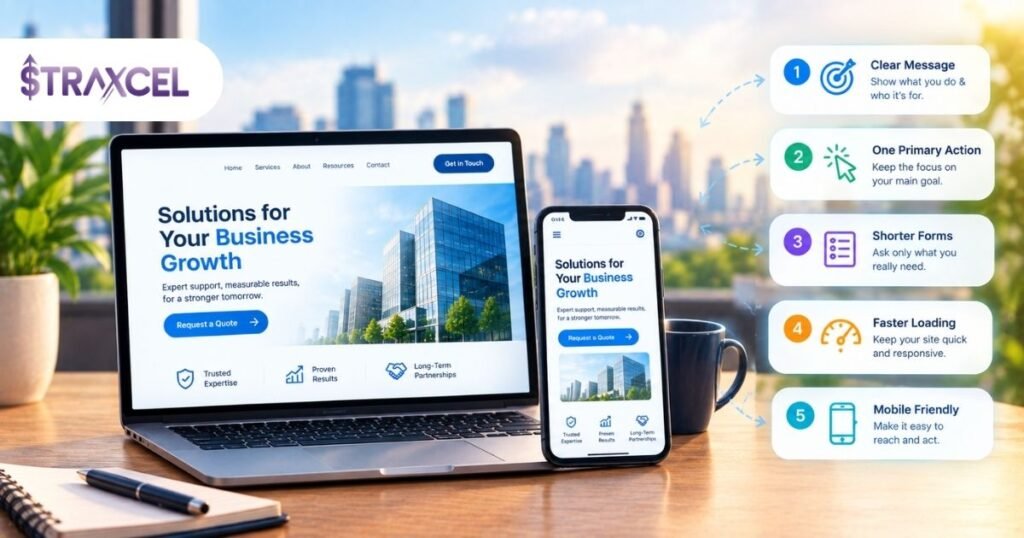
Website UX For Lead Generation : 9 Fixes That Increase Leads I once audited a B2B website for a client with genuinely healthy traffic, thousands of visitors a month, and an enquiry rate sitting under half a percent. The team assumed the problem was visibility, that they simply needed more traffic. It wasn’t. The real issues were a nine-field enquiry form, a homepage headline that described the company instead of what it actually did for the visitor, and a contact page that took several seconds just to acknowledge a tap. None of that shows up in a traffic report. All of it shows up in the enquiry number. Website UX for lead generation is a narrower job than UX in general, and that’s exactly what most generic advice on this topic misses. You’re not designing for browsing. You’re optimising one specific decision – should this person hand over their contact details? Everything on the page either supports that decision or gets in its way. What This Actually Means It means designing around the enquiry, not around how impressive the brand looks. A website can win design awards and still fail completely at this one job. The real test is simple – can a stranger land on your page, understand your offer, believe you can deliver it, and start a conversation in under a minute? This is where good-looking design and good conversion design can actually pull in opposite directions. An animated hero section that pushes your actual offer below the first screen is a loss, even if the client loves how it looks. A chat widget sitting on top of your main call-to-action button on a small phone screen is the same problem in a different form. Where Enquiries Actually Leak Before changing anything, it’s worth figuring out where the drop-off genuinely happens. Redesigning a page whose real problem sits three steps later just wastes effort. Symptom Usual Cause What to Fix Good traffic, almost no form starts Unclear offer above the fold, or too many competing CTAs Fixes 1 and 2 People start the form but abandon it Too many fields, or an unexplained phone number requirement Fix 3 Mobile converts far worse than desktop Poor tap targets, wrong keyboard type, no click-to-call Fix 5 Enquiries come in but quality is poor No qualifying step anywhere in the flow Fix 7 Bounce spikes on one specific page Slow loading or unresponsive buttons on that template Fix 4 Enquiries rarely turn into actual calls Slow follow-up and a weak thank-you page Fix 9 The 9 Fixes, Ordered From Easiest Wins to Bigger Projects 1. Say What You Do and Who It’s For, in the First Screen Your homepage’s first screen has exactly one job – answer what you do, who it’s for, and what someone should do next. A vague line like “Building Tomorrow Together” sounds nice and tells nobody anything useful. Write the sentence your actual customer would say if someone asked what you do. Here’s a quick test. Cover everything below the first screen and ask someone unfamiliar with your business what you actually offer. If they can’t answer in a few seconds, the copy isn’t clear enough yet. Fixing this single sentence often moves the needle more than a full website redesign. 2. Give Each Page One Primary Action Most lead pages try to do too much at once – request a quote, download a guide, book a call, subscribe to a newsletter, all competing for the same click. When everything is a priority, nothing performs well. Pick one primary action per page and turn everything else into a simple text link instead of another button. On a dedicated landing page built for enquiries, the enquiry button should be the obvious action, and anything like a case study link should sit quietly in the background. Never give two actions equal visual weight on the same page. 3. Cut Your Form to the Fields Your Sales Team Actually Uses Most enquiry forms carry far more fields than they need. Research from usability studies has found large sites averaging close to 13 form fields when 6 to 8 would genuinely do the job, and a significant share of users abandon a form purely because it feels too long. Sit with your sales team and go through your form field by field. Ask honestly which ones they actually look at before the first call. Fields like company size, budget range, or “how did you hear about us” rarely survive that conversation. Four fields is a solid default – name, work email or phone number, company, and a short message. 4. Fix Whatever’s Slowing Down Interaction on Your Site Google measures site speed using a few clear thresholds – your largest content should load under 2.5 seconds, your page should respond to interaction within 200 milliseconds, and visual stability should stay tight. That interaction speed metric matters more than most site owners realise, because it measures the actual delay someone feels after tapping your enquiry button. This isn’t just a technical vanity metric either. Real businesses have seen measurable revenue gains simply from improving load speed on key pages. If you’re working on this, start with your highest-traffic service page, not necessarily your homepage. 5. Design Your Mobile Enquiry Path as Its Own Thing Mobile isn’t just your desktop site squeezed onto a smaller screen. Tap targets need proper spacing so people don’t miss buttons, phone number fields should trigger the numeric keypad automatically, and a sticky call button makes sense on pages where someone might genuinely prefer to just call rather than fill out a form. Test your site on a normal Android phone over regular mobile data, not the latest flagship connected to office WiFi. A responsive layout fixes how things look on a small screen. It doesn’t automatically fix whether the enquiry process actually works well there, and those are genuinely two different problems. 6. Put Proof Right Next to the Ask A testimonials page tucked away

LinkedIn Shares New Insights Into Younger Professionals (Straxcel Business Solutions)
Social Media Updates, LINKEDIN

LinkedIn Shares New Insights into Younger Professionals

LinkedIn Shares New Insights Into Younger Professionals LinkedIn has published new research based on a survey of over 18,000 professionals, looking at how Gen Z is approaching the workforce and what marketers need to know to connect with them. On the professional side, 72% of Gen Z professionals say they’re missing out on opportunities because they hesitate to reach out, citing fear of bothering people (37%), being judged (37%), or sounding inauthentic (34%). Over half, 53%, aren’t sure how to even start networking professionally. This matters because LinkedIn found 27% of Gen Z professionals landed their next opportunity through online professional communities, and job applicants with an inside connection were nearly 7 times more likely to get hired than those without one. On the marketing side, the data is just as telling. 9 in 10 marketers agree future growth depends on influencing younger decision-makers. 42% say content from expert voices is the most effective way to connect with this audience. 86% of marketers agree Gen Z and millennial buyers trust peer recommendations and expert voices more than branded marketing. And 49% of Gen Z buyers are most likely to engage with short-form and immersive video. Brand credibility is also outweighing brand visibility for this generation, with 73% of respondents saying credibility now matters more than simply being seen. What This Means For Brands and Marketers in India If you’re trying to reach Gen Z professionals or consumers, this data points clearly toward one format: short-form video featuring genuine expert voices, not polished branded ads. This audience trusts real perspective over marketing gloss, so investing in named, authentic content, from your own team or credible voices in your space, is likely to outperform generic brand messaging with this group. Clients Also Ask Why is Gen Z hesitant to network on LinkedIn despite it being where opportunities live? The fear isn’t really about the platform, it’s social anxiety around reaching out at all. That gap between where opportunities exist and how comfortable people feel pursuing them is a real signal for employers and platforms alike, not just a personality trait of this generation. Brands and recruiters who make the first move, rather than waiting to be approached, will likely see better engagement from this group. Does this mean brands should stop running traditional branded ads to Gen Z? Not entirely, but the data is a clear warning against relying on branded messaging alone. With 86% of marketers agreeing this audience trusts peer and expert voices more than brand marketing, the smarter move is pairing any branded campaign with genuine expert or employee-voice content, not replacing one with the other outright. What kind of content actually works best with LinkedIn audience? Short-form and immersive video featuring real expert insight is the clear standout in this data. This isn’t just a content format preference, it reflects a deeper trust pattern, this generation responds to perceived authenticity and expertise far more than production value or brand polish. How does this affect B2B marketing specifically? Significantly. With 9 in 10 marketers agreeing future growth depends on influencing younger decision-makers, B2B brands need to start building relationships with Gen Z now, even before they’re the ones signing off on purchases. Waiting until they’re in senior roles to start engaging them means starting from zero trust at a critical decision point. Should companies change how they encourage employee networking internally? Yes, and this is arguably the most actionable insight here. With over half of Gen Z professionals unsure how to start networking, companies that actively build structured mentorship or connection programs internally are likely to see stronger engagement and retention from younger employees than those who leave networking entirely up to individual initiative. Recommended For You LinkedIn Shares New Insights into Younger Professionals Learn more Top 20 Expert Tips For Performance Marketing : Why Decision-Making is Your Real ROAS Engine Top 20 Expert Tips For Performance Marketing : Why Decision-Making Is Your Real ROAS Engine… Learn more Where I See Digital Marketing Heading Over the Next 5 Years Where I See Digital Marketing Heading Over the Next 5 Years Look back at India’s… Learn more Author Profile STRAXCEL blogs are written by Mr. Subham Sarkar, who has extensive level of experience and expertise and helped 100+ startups to excel their revenue. Post Categories 360 Digital Marketing Business Development Expert Answers Clients Results Founder Insights Service Guides AI Tools Industry Insights What We Offer Full-stack Website Development Search Engine Optimization Generative Engine Optimization Social Media Management Mobile App Development Performance Marketing Content Creation Latest Updates Full-stack Website Development Search Engine Optimization Generative Engine Optimization Social Media Management Mobile App Development Content Creation Joke of the Day Performance marketers don’t sleep, they just refresh the dashboard every 4 hours and call it self-care.

Top 20 Expert Tips for Performance Marketing Why Decision-Making Is Your Real ROAS Engine (Straxcel Business Solutions)
Performance Marketing

Top 20 Expert Tips For Performance Marketing : Why Decision-Making is Your Real ROAS Engine

Top 20 Expert Tips For Performance Marketing : Why Decision-Making Is Your Real ROAS Engine I’ve reviewed enough performance marketing accounts by now to notice a pattern that surprised me early in my career. The accounts that struggled almost never had a tools problem or a budget problem. They had a decision-making problem. Someone was reacting to a single bad day of data, or holding onto a losing campaign out of stubbornness, or scaling a winning ad too aggressively without asking why it was winning in the first place. The platforms, the creative, the targeting, all of that matters. But the actual engine behind consistent ROI is how well someone reads data and makes calls under pressure. Here are the 20 things I actually tell teams and founders when we’re building out a performance marketing strategy together, based on what I’ve seen separate accounts that scale profitably from accounts that burn cash. 1. Define Your Real Target Action Before You Touch a Platform Before opening Meta Ads Manager or Google Ads, get brutally specific about what a “win” actually looks like, a sale, a qualified lead, a booked call. Vague objectives lead to vague optimisation, and every downstream decision, from bidding to creative, gets built on that first choice. 2. Know Your Actual Margin Before You Set a Target CPA You can’t set a sensible cost per acquisition target without knowing your real profit margin per sale. I’ve seen businesses chase a CPA that looked impressive on a dashboard but was actually eating their entire margin once returns, discounts, and overhead were factored in. 3. Let Data Talk for at Least a Week Before Reacting One bad day doesn’t mean a campaign is broken, and one great day doesn’t mean you’ve found a winner. Give a new campaign or a new creative enough time, usually 5 to 7 days, for the platform’s algorithm to gather enough data to actually mean something. 4. Separate Testing Budget From Scaling Budget Keep a clear line between money spent testing new ideas and money spent scaling what’s already proven. Mixing the two makes it nearly impossible to tell whether your account is actually growing or just fluctuating. 5. Track Cost Per Click and Conversion Rate Separately, Not Just Cost Per Acquisition A rising CPA can come from two very different places, more expensive clicks or a landing page that’s converting worse. Looking only at the final number hides which problem you’re actually solving. 6. Build at Least 3 to 5 Creative Variants Before Launch A single ad variant tells you almost nothing about what’s actually working, the hook, the visual, or the offer. Launch with real variation so you can isolate what’s driving performance instead of guessing. 7. Watch Frequency Closely on Paid Social When the same person sees your ad too many times, performance drops even if everything else stays the same. Once frequency starts climbing past 3 to 4 within a week or two, that’s usually your signal to refresh creative. 8. Don’t Confuse a Slow Landing Page With a Bad Ad I’ve seen strong ads written off as underperforming when the real issue was a landing page taking too long to load on mobile. Always check the full funnel before blaming the ad itself. 9. Use Lookalike Audiences Once You Have Enough Real Conversion Data Lookalike targeting only works well once your source audience, your actual paying customers, is large and clean enough to build from. Building one off 20 random leads usually does more harm than good. 10. Retarget Based on Intent, Not Just Visits Someone who scrolled your homepage for 3 seconds is not the same as someone who added a product to cart. Segment your retargeting by actual behaviour, not just a blanket “everyone who visited” audience. 11. Set a Clear Rule for When You Kill a Campaign Decide your kill criteria in advance, a specific CPA threshold or a set budget spent with zero conversions, before you launch. Deciding in the moment, when emotions and sunk cost are involved, leads to campaigns running far longer than they should. 12. Don’t Scale a Winning Ad by More Than 20 to 30 Percent at a Time Jumping a budget too fast resets the algorithm’s learning phase and often tanks performance right when you thought you’d found a winner. Scale in small, steady increments instead. 13. Track Customer Lifetime Value, Not Just First-Purchase CAC A high acquisition cost can still be a great decision if that customer sticks around and buys again. Looking only at first-purchase numbers can lead you to cut channels that are actually profitable long term. 14. Build Your Tracking Infrastructure Before You Scale Spend If your data attribution is shaky, scaling your budget just means scaling your mistakes faster. Get server-side tracking and clean conversion data sorted before you push more money into any channel. 15. Match Your Payment Model to Your Business Type A B2B business chasing leads should be optimising toward cost per lead, not cost per click. An e-commerce brand should be watching cost per acquisition against real margin. Using the wrong model as your north star quietly misguides every decision after it. 16. Review Your Channel Mix Monthly, Not Once a Year Auction costs shift, competitors change tactics, and audience behaviour moves. A budget split that made sense three months ago can quietly become inefficient if nobody’s actively rechecking it. 17. Don’t Ignore Small, Consistent Losses A campaign losing a small amount steadily can be more dangerous than one obvious big failure, because it’s easy to overlook. Set a regular cadence to review every active campaign, not just the ones that stand out. 18. Question a Sudden Spike in Performance Before Celebrating It A dramatic overnight improvement is sometimes a genuine breakthrough, and sometimes a tracking glitch or an unusual audience overlap. Verify before you shift strategy based on one unusually good result. 19. Keep a Written Log of Every Major Decision and Why You Made It When a campaign underperforms

Where I See Digital Marketing Heading Over the Next 5 Years (Straxcel Business Solutions)
Founder Insights

Where I See Digital Marketing Heading Over the Next 5 Years

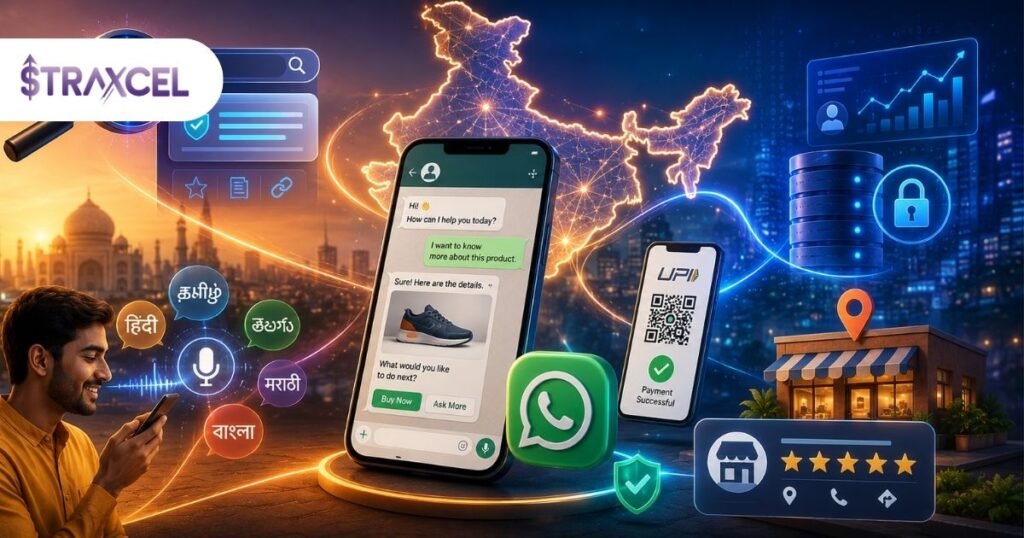
Where I See Digital Marketing Heading Over the Next 5 Years Look back at India’s digital landscape just five years ago, and it already feels like a different country. We went from patchy 4G to genuinely fast 5G. UPI turned into a payment system the rest of the world now studies. And hundreds of millions of new users from Tier-2 and Tier-3 cities came online, not as an afterthought, but as the actual centre of growth. If you think that pace is slowing down, I’d push back on that hard. Working in this market every day, I see the next five years bringing an even bigger shift in how Indian consumers find, evaluate, and buy from brands. Here’s where I genuinely believe things are headed, and what businesses need to start building toward now. 1. Search Stops Being About Links and Starts Being About Answers For years, the entire point of SEO was simple, rank on page one, get the click, send someone to your website. That model is already cracking. With AI now built directly into how people search, through Google’s AI-generated summaries, ChatGPT, and other answer-focused tools, more and more people are getting a complete answer without ever clicking through to a website at all. Over the next five years, I expect traditional SEO to mature fully into what’s increasingly called Generative Engine Optimization, or GEO. The competition won’t just be about keyword density anymore. It’ll be about becoming the source an AI system actually trusts and cites when someone asks a real question. Winning this means building genuine topical authority, publishing real first-party research and detailed case studies, and making sure your brand has authentic, verifiable sentiment across forums and review platforms. If an AI engine can’t confirm your credibility through independent sources across the web, it simply won’t recommend you, no matter how polished your own website looks. 2. Checkout Moves Into the Chat, Permanently India skipped the desktop era almost entirely. Most of our digital population interacts with the internet purely through a phone screen, yet a lot of brands are still funnelling mobile users through slow, multi-step website checkouts built for a different era. I think the standalone checkout page is going to keep losing ground to fully conversational commerce over the next five years. The entire journey, from seeing an ad to getting support after a purchase, increasingly lives inside one chat interface, largely through WhatsApp, backed by AI assistants and UPI payments built directly into the conversation. Someone sees a short video ad, taps to chat, asks a quick question to an AI assistant, picks their option, and pays, all without ever leaving the app. Brands that build around this instead of forcing people back onto a website are going to see meaningfully better conversion rates and lower acquisition costs. 3. The Real Growth Is in Regional Languages, Not English The next wave of India’s digital growth doesn’t come from English-speaking metro users. It comes from the next few hundred million people entering the digital economy from smaller cities and towns, and they’re engaging with their phones very differently, largely through voice, in their own language. Over the next five years, I expect voice searches in Hindi, Tamil, Telugu, Marathi, Bengali, and other regional languages to genuinely outpace text-based English searches in a lot of categories. The mistake I already see brands making is running their English content through basic translation tools and calling it done. That produces stiff, robotic content that misses how people actually speak. The brands that win here are the ones building content around natural, conversational, regional phrasing from the ground up, not translating an English strategy after the fact. 4. Owning Your Own Data Becomes Non-Negotiable With India’s Digital Personal Data Protection Act now fully in force, alongside the broader industry move away from third-party tracking cookies, the era of relying on a basic browser pixel and hoping Meta or Google figures out your ideal customer is over. Businesses still leaning entirely on that approach are already seeing their ad performance quietly erode. I think the next five years turn digital marketing into as much of a data engineering discipline as a creative one. The brands pulling ahead are investing in proper server-side tracking, connecting their CRM data directly to ad platforms through tools like Meta’s Conversions API, and building genuinely useful tools, calculators, quizzes, product recommendation engines, that collect real customer data transparently, in exchange for something useful to the customer. Owning that data pipeline isn’t just about better targeting anymore. It’s what keeps a business compliant while everyone else scrambles to catch up. 5. Local Search Decides Who Actually Gets the Customer As connectivity keeps expanding across smaller cities and towns, “near me” searches keep climbing, and this affects far more businesses than people realise, clinics, retail chains, dealerships, distribution hubs, anyone with a physical footprint. Over the next five years, I expect businesses that ignore their local digital presence to keep losing ground to smaller, more agile competitors who simply got the basics right. Winning this means real investment, not shortcuts, keeping your business name, address, and phone number completely consistent everywhere online, building a proper dedicated page for every location you operate, and consistently earning genuine, keyword-rich Google Business Profile reviews rather than chasing volume with fake ones. Where This All Leads The next five years in Indian digital marketing belong to businesses that build real infrastructure instead of chasing shortcuts, that remove friction from the buying experience instead of adding more steps, and that genuinely speak to their customers in the language and format they actually use, not a translated or repurposed version of something built for a different market. The playbooks that worked five years ago are already fading. The businesses investing in these foundations today are the ones that’ll still be relevant when this shift fully plays out. Clients Also Ask What is the biggest change coming to digital marketing in India over the next five years? The shift

How Long Does It Take to See Results From SEO (Straxcel Business Solutions)
Expert Answers

How Long Does It Take to See Results From SEO? The Definitive, No-Nonsense Timeline

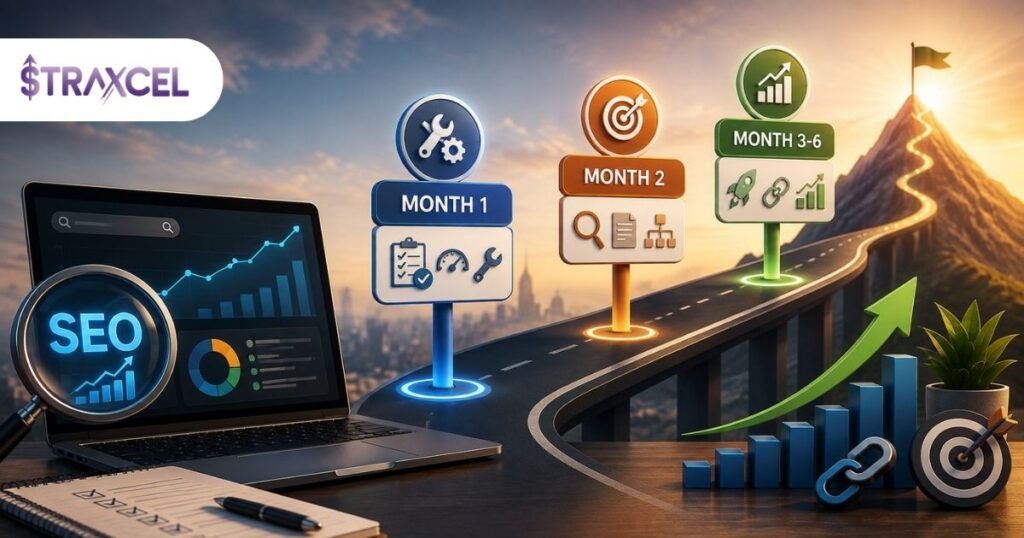
How Long Does It Take to See Results From SEO? A founder asked me this exact question in our very first call, and when I gave him a straight answer instead of the usual “it depends,” he actually laughed. He said every other agency he’d spoken to had dodged the question completely. I get why agencies dodge it, SEO genuinely does vary case by case, but if you’re the one signing off on the budget, “it depends” isn’t an answer you can plan a business around. So let me give you the real timeline, based on what actually happens behind the scenes, not the vague version most agencies default to. The Short Answer : 4 to 12 Months For a properly executed SEO campaign, expect measurable business results somewhere between 4 and 12 months. That’s not a guess, it’s roughly how long it physically takes for search engines to discover your changes, evaluate your site, and adjust your rankings across a competitive market. Phase Timeframe What’s Actually Happening Foundation & Repair Month 1 Technical fixes, site speed improvements, initial indexing Traction & Engagement Months 1-2 Keyword positions shift, impressions rise, early organic leads appear Compounding Scale Months 3-6 Domain authority builds, top rankings stabilise, revenue becomes predictable Why It Actually Takes This Long This isn’t agencies being slow. It’s how Google’s systems work. When you publish or update a page, Google doesn’t know instantly. Its crawler has to discover the page, read through the content, understand how it links to the rest of your site, and only then decide where it belongs in the rankings. For larger sites or newer domains, that crawl cycle alone can take days or weeks before anything even gets evaluated. There’s also something in the industry often called the sandbox effect. When a new website launches, or an existing site suddenly starts publishing a lot of new content, Google treats it with some scepticism at first. It wants to see consistency over time, is the site staying online, is it genuinely getting updated, are other credible websites linking to it naturally, are visitors actually sticking around once they land. Building that trust takes months of steady, honest signals. There’s no shortcut around this part, no matter what an agency promises. What Actually Changes Your Specific Timeline Not every business starts from the same place, and a few factors genuinely shift how fast you’ll see results. Your domain’s history matters a lot. A brand-new website with zero track record typically needs 9 to 12 months or more, since Google has no history to build trust from. An older website that’s simply neglected SEO for years can often see meaningful jumps in 3 to 6 months, because fixing existing technical issues and cleaning up what’s already there tends to unlock faster gains than building from scratch. Your competition shapes the timeline too. A local business, say a dental clinic in one neighbourhood, is realistically competing against a handful of other local clinics, and can often reach the top local map results within 3 to 4 months with focused local SEO work. A business trying to rank nationally for something like “best payroll software” is up against companies that have invested in content for a decade, and that fight genuinely takes 12 months or more. How fast you can execute matters more than people expect. A business publishing one blog post a month, with developer fixes taking six weeks to go live, is looking at 12 months or longer. A business that can deploy code fixes quickly and publish several well-researched pieces a week can compress that same journey into 4 to 6 months. Your backlink profile plays a role as well. Genuine mentions and links from credible websites act like votes of confidence in Google’s eyes. A brand that already has some natural backlink authority will see new content rank faster than one starting from nothing. What a Real 6-Month SEO Campaign Actually Looks Like To make this less abstract, here’s roughly what a properly run campaign looks like month by month. Month 1 is entirely foundational. Deep technical audits using tools like Semrush, Ahrefs, or Screaming Frog to find hidden issues. Fixing broken links, cleaning up duplicate content, correcting redirect errors, and getting the site loading fast, ideally under two seconds on mobile. Alongside that, proper analytics setup, verifying Google Search Console, configuring GA4, and making sure conversion tracking is actually accurate. Month 2 shifts to structure and strategy. Deep keyword research organised around actual intent, not just search volume, building out content into organised topic clusters so Google can clearly see how your pages relate to each other, and studying what competitors are ranking for that you currently aren’t. Also this is where content production genuinely ramps up. In-depth articles and guides built around real buyer intent, internal links connecting your blog content to your key service pages so ranking strength flows through the site, and refining page layouts to convert the traffic that’s starting to arrive. Month 3-6 is usually the turning point psychologically, and it’s important to know this in advance. This is when Google Search Console starts showing a real lift in impressions, meaning your pages are appearing in search results more often, even before clicks catch up. Keywords that were buried on page 5 or 6 start climbing toward page 2 and 3. Then it shifts focus outward, building genuine authority through digital PR and outreach, updating earlier content with fresh data based on what’s performing, and pushing local SEO signals if that’s relevant to the business. Then it compounds into actual business results. Core commercial keywords reaching page one, organic traffic scaling steadily month over month, and a genuinely predictable flow of leads or sales starting to show up. How to Know It’s Working Before the Revenue Shows Up The single most common mistake I see is a business panicking around month 3, right before the real momentum builds, and pulling the plug. To avoid that, track the right signals early.

LinkedIn Says 1 Million People Have Reported AI Slop (Straxcel Business Solutions)
LINKEDIN, Social Media Updates

LinkedIn Says 1 Million People Have Reported “AI Slop”

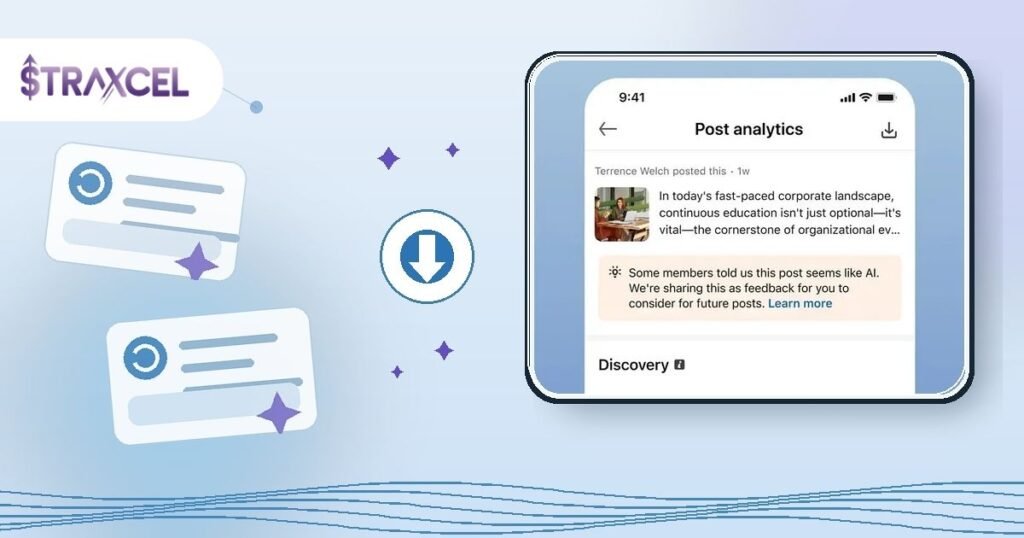
LinkedIn Says 1 Million People Have Reported “AI Slop” LinkedIn’s “seems like AI slop” reporting option, launched earlier this month, has already been used by more than a million people in its first two weeks, according to Chief Product Officer Hari Srinivasan. LinkedIn defines AI slop as content that looks polished but has no real substance, no genuine experience, perspective, or insight, just generic text posted to grab attention without effort. Using AI to refine your writing isn’t the target here. Empty, low-effort posts are. Importantly, LinkedIn clarified that reporting a post as AI slop doesn’t reduce that post’s overall distribution on the platform. It only affects what the reporting user personally sees in their own feed going forward. A post only takes a real distribution hit if a large number of people report the same concern, since LinkedIn weighs many signals together rather than acting on individual reports. LinkedIn is also rolling out notifications to creators who receive a high volume of AI slop reports, aiming to inform rather than punish. The impact so far : content LinkedIn classifies as AI slop is seeing 40% fewer views than just a few weeks ago. What This Means For Brands and Creators in India If you’re posting on LinkedIn for business, this is a clear signal to prioritise genuine insight and real experience over generic, AI-polished filler. LinkedIn is actively building signals to detect and suppress low-substance content, and getting flagged repeatedly could quietly shrink your reach over time, even without a formal penalty. Using AI to tighten your writing is still fine. Using it to generate the substance of your posts is where this starts working against you. Clients Also Ask Will using AI to write my LinkedIn posts get me penalised? Not directly, and LinkedIn has been explicit about this. Using AI to refine your language or tighten a draft isn’t the issue. The problem is posting content with no real perspective or experience behind it, AI-written or not. A well-reasoned post edited with AI assistance is treated very differently from a generic AI-generated post with nothing behind it. How much does one AI slop report actually hurt my content? Very little on its own. LinkedIn has confirmed a single report only affects what that individual user sees in their feed, not your post’s overall distribution. The real impact only shows up when a meaningful number of people flag the same content, which is a much stronger signal that something’s genuinely low-value. Should I be worried about getting flagged if my writing sounds polished? Polish itself isn’t the issue, substance is. LinkedIn’s own definition specifically separates “sophisticated presentation” from actual insight or experience. If your post reflects a real point of view or genuine expertise, sounding well-written shouldn’t work against you. The risk is when polish is the only thing the post has going for it. What’s the actual business impact of this for brands using LinkedIn? Content classified as AI slop is already seeing a real, measurable drop, about 40% fewer views since the option launched. For brands running LinkedIn as part of their marketing mix, this is a signal to invest in genuinely useful, experience-backed content rather than volume-driven, generic posting, since the platform is actively working to suppress the latter. Recommended For You LinkedIn Says 1 Million People Have Reported “AI Slop” LinkedIn Says 1 Million People Have Reported “AI Slop” LinkedIn’s “seems like AI slop” reporting… Learn more What I Tell Every Founder Before They Scale Their Ad Spend What I Tell Every Founder Before They Scale Their Ad Spend There’s a moment almost… Learn more Meta Testing Keyword-Triggered Auto-DMs on Instagram Ads Meta Testing Keyword-Triggered Auto-DMs on Instagram Ads Meta is testing a new feature called Reply… Learn more Author Profile STRAXCEL blogs are written by Mr. Subham Sarkar, who has extensive level of experience and expertise and helped 100+ startups to excel their revenue. Post Categories 360 Digital Marketing Business Development Expert Answers Clients Results Founder Insights Service Guides AI Tools Industry Insights What We Offer Full-stack Website Development Search Engine Optimization Generative Engine Optimization Social Media Management Mobile App Development Performance Marketing Content Creation Latest Updates Full-stack Website Development Search Engine Optimization Generative Engine Optimization Social Media Management Mobile App Development Content Creation Joke of the Day Performance marketers don’t sleep, they just refresh the dashboard every 4 hours and call it self-care.

What I Tell Every Founder Before They Scale Their Ad Spend (Straxcel Business Solutions)
Founder Insights

What I Tell Every Founder Before They Scale Their Ad Spend

What I Tell Every Founder Before They Scale Their Ad Spend There’s a moment almost every founder hits, and I’ve watched it play out enough times to recognise it instantly. You’ve found product-market fit, your first campaigns are profitable, there’s some cash sitting in the bank, and the logic feels obvious – double the budget, double the revenue, scale fast. I’ve had founders come to me genuinely surprised when that logic didn’t hold. They took their daily spend from ₹50,000 to ₹2,00,000, expecting revenue to follow proportionally, and instead watched their return on ad spend collapse and their acquisition costs spike, burning through serious money in weeks. Scaling ad spend isn’t a simple math problem where more input equals more output. It changes the entire system underneath your campaigns. Before anyone turns that dial up, here’s what I actually walk them through. The Algorithm Doesn’t Scale the Way You Think It Does At a modest budget, ad platforms like Meta and Google are working in ideal conditions. They can afford to be selective, finding the smallest, most obviously interested slice of your audience, the people most likely to buy. That’s why your early campaigns often look deceptively efficient. The moment you scale your budget, you force the algorithm out of that comfort zone. To actually spend the extra money, it has to reach further, into broader, less qualified audiences who weren’t part of that original high-intent pool. Your conversion rate drops. Your acquisition cost climbs. This isn’t a sign something broke, it’s just how auction-based advertising behaves at higher volume. Before you scale, ask yourself honestly whether your business can absorb a 20 to 30 percent rise in acquisition costs and still stay profitable. If the answer is no, you’re not ready to increase spend yet, no matter how good last week’s numbers looked. Figure that stress-test number out before you scale, not after you’ve already spent the money finding out the hard way. Your Creative Will Burn Out Faster Than You Expect At a smaller budget, a good video ad can run for months without anyone getting tired of it, simply because your audience is large enough relative to your spend. Scale the budget, and you burn through that same audience pool much faster. People start seeing your exact ad multiple times a week, and once that happens, click-through rates drop and performance fatigues fast. Here’s the part founders often miss – scaling your ad spend is really a commitment to scaling your creative production at the same time. If you don’t have a team, in-house or through an agency, capable of producing a genuine stream of fresh video hooks and format variations every week, your scaled campaign will likely crash within a couple of weeks, not because the strategy was wrong, but because the creative simply ran out of runway. Your Data Has to Be Solid Before You Spend More on It If you’re relying purely on basic browser-based tracking to guide decisions at scale, you’re working with incomplete information, and the margin for error gets expensive fast. A data gap that barely matters at a small budget can translate into real money wasted once you’re spending heavily. Before scaling, I’d want to see server-side tracking in place, a direct connection between your platform and your backend, like Meta’s Conversions API, so the algorithm gets clean conversion data instead of relying on browser signals alone. I’d also want an independent view of performance, a dashboard that cross-checks what the ad platform claims against what’s actually landing in your bank account, because those two numbers don’t always match. And ideally, some visibility into how your channels interact, understanding how your Google campaigns are catching traffic that a Meta ad first introduced, rather than treating each platform as if it worked in isolation. What Happens After the Click Matters More Than the Ad Itself An ad’s only job is to get someone to click. What happens next decides whether that click turns into revenue, and this is where I see founders look in the wrong place when scaling stalls. They keep tweaking the ad account when the actual problem is sitting on their website. A slow-loading page costs you conversions before someone even sees your offer properly. A checkout that demands a long form, account creation, or doesn’t support quick UPI payment will lose scaled traffic fast, even if the ad itself was excellent. For a lot of businesses, shifting part of that funnel toward conversational commerce, letting people complete a purchase through a WhatsApp chat instead of a full website checkout, removes a lot of that friction and holds up much better under higher traffic volume. Scale With Discipline, Not Excitement Don’t scale your ad spend just because last week looked good. Scale because your business has genuinely earned the right to, meaning your margins can absorb rising costs, your creative pipeline can keep pace, and your tracking data is something you actually trust. When you do scale, do it in small steps, something like 15 to 20 percent every few days, giving the algorithm’s learning phase time to stabilise while you watch your actual cash flow, not just the ad platform’s own reported numbers. Real scale isn’t a single bold decision. It’s a controlled, patient process, and the founders who treat it that way are the ones who end up scaling successfully instead of burning through their reserves finding out the hard way. Clients Also Ask Why does my ROAS drop when I increase my ad budget? This happens because ad platforms have to reach broader, less targeted audiences to spend a larger budget, moving beyond the smaller pool of high-intent users your original campaign was reaching. It’s a normal effect of scaling, not necessarily a sign your strategy is broken, but it does mean your business needs to be able to absorb higher acquisition costs before scaling further. How much should I increase my ad spend at a time? A common, safer approach is increasing spend

Meta Testing Keyword-Triggered Auto-DMs on Instagram Ads (Straxcel Business Solutions)
Social Media Updates, META

Meta Testing Keyword-Triggered Auto-DMs on Instagram Ads

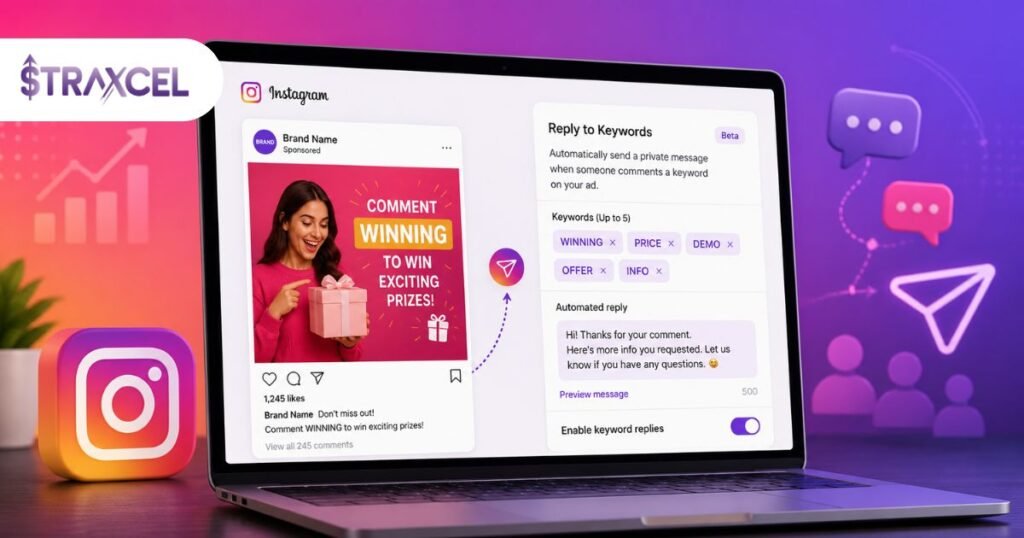
Meta Testing Keyword-Triggered Auto-DMs on Instagram Ads Meta is testing a new feature called Reply to Keywords, now appearing in Instagram ad setup tools for some advertisers. It lets brands pick up to five keywords, and whenever someone comments one of those keywords on a promoted post, Instagram automatically sends them a private DM. The idea is simple : an ad could say “comment WINNING for more info,” and instead of a team member manually replying to every comment, Instagram’s system sends the follow-up DM automatically. It’s built to speed up lead nurturing directly from ad comments, without any manual work on the advertiser’s side. A version of this already exists through Meta’s inbox automation and Business Agent tools, but this ties the same functionality directly into Instagram’s ad setup, making it easier to trigger from a single promoted post. For now, it’s only showing up for Instagram ads, not Facebook. What This Means For Advertisers in India This is a low-effort way to turn ad comments into a direct lead-nurturing channel without adding manual work for your team. If you’re running Instagram ad campaigns, it’s worth testing keyword-based CTAs like “comment for pricing” or “comment DEMO,” since a warm DM follow-up often converts better than someone having to leave the app to fill out a form. Worth noting: this is still a limited test, so availability may vary by account, and there’s no confirmed wider rollout date yet. Clients Also Ask Will this replace the need for a team member to manage DMs? Not entirely. This handles the first response well, but any real conversation past that initial keyword-triggered DM still needs a person or a more advanced automation tool to carry it forward. Think of it as a fast first touch, not a full replacement for follow-up. Is this actually useful, or just a gimmick? It’s genuinely useful for one specific job : reducing the lag between someone showing interest in a comment and getting a response. In my experience, response speed on social media directly affects conversion, so even this simple a feature can meaningfully improve lead quality if you’re getting decent comment volume on your ads already. Should I switch my ad CTAs to use this now? If you’re already running Instagram ads and have access to the test, it’s worth trying on one campaign before rolling it out everywhere. Test a clear, simple keyword against your current CTA and compare DM response rates and follow-through, rather than assuming it’ll automatically outperform what you’re doing now. Why is this only on Instagram and not Facebook ads yet? Meta has been pushing DMs as a growing channel for consumer-to-business interaction for a while now, and Instagram tends to get these conversational features first since DM usage skews heavier there. It’s reasonable to expect this to expand to Facebook ads eventually if the test performs well, but there’s no confirmed timeline yet. Does this fit into a bigger trend worth watching? Yes. Meta’s been steadily investing in DM-based business tools as messaging becomes a bigger part of how people interact with brands online. Advertisers who get comfortable building keyword-triggered and automated DM flows now will likely have an easier time adapting as Meta rolls out more advanced conversational ad tools down the line. Recommended For You Meta Testing Keyword-Triggered Auto-DMs on Instagram Ads Learn more Semrush vs Ahrefs : Which SEO Tool Should You Actually Buy Semrush vs Ahrefs : Which SEO Tool Should You Actually Buy Every few weeks, a… Learn more Top Digital Marketing Trends To Excel Your Business in India Top Digital Marketing Trends To Excel Your Business in India A client of mine, someone… Learn more Author Profile STRAXCEL blogs are written by Mr. Subham Sarkar, who has extensive level of experience and expertise and helped 100+ startups to excel their revenue. Post Categories 360 Digital Marketing Business Development Expert Answers Clients Results Founder Insights Service Guides AI Tools Industry Insights What We Offer Full-stack Website Development Search Engine Optimization Generative Engine Optimization Social Media Management Mobile App Development Performance Marketing Content Creation Latest Updates Full-stack Website Development Search Engine Optimization Generative Engine Optimization Social Media Management Mobile App Development Content Creation Joke of the Day Performance marketers don’t sleep, they just refresh the dashboard every 4 hours and call it self-care.

Semrush vs Ahrefs - Which SEO Tool Should You Actually Buy (Straxcel Business Solutions)
Tool Comparisons

Semrush vs Ahrefs : Which SEO Tool Should You Actually Buy

Semrush vs Ahrefs : Which SEO Tool Should You Actually Buy Every few weeks, a founder or marketing lead asks me some version of the same question. “We can only justify budget for one SEO tool right now, Semrush or Ahrefs, which one do we actually buy?” It’s a fair question, because both tools cost real money every month, and picking the wrong one means either overpaying for features you’ll never touch, or hitting a wall the moment your actual work needs something the tool doesn’t do well. I’ve run both tools across different client accounts for years, and the honest answer has genuinely shifted over the last couple of years. Ahrefs moved to a usage-based credit system that changes how teams need to budget their actual usage, and Semrush has expanded hard into becoming a full marketing suite, not just an SEO tool. Let me walk you through where each one actually wins, with real numbers, so you can make the call based on your own situation instead of a generic recommendation. What Each Tool Was Actually Built to Do Both platforms call themselves complete SEO suites, but they were built with genuinely different priorities in mind. Semrush Ahrefs Core strength Broad marketing ecosystem – SEO, PPC research, social, content Deep, unmatched backlink and link intelligence data Best suited for Agencies, in-house marketing teams, full-service growth teams Technical SEO specialists, link builders, niche content publishers Keyword database Over 25 billion keywords with strong intent categorisation Deep multi-engine data including Google, YouTube, Amazon, Bing Site audit style Visual, beginner-friendly, guided fixes Deep, highly technical, built for SEO purists Keyword Research : Two Different Philosophies Semrush’s Keyword Magic Tool leans on its enormous keyword database, and its real strength is how accurately it categorises search intent – informational, navigational, commercial, or transactional – across nearly every keyword you look up. It also gives strong, near real-time cost-per-click and advertiser competition data, which matters a lot if you’re running paid campaigns alongside your organic strategy. Ahrefs takes a different angle with its Keywords Explorer. It pulls search volume not just from Google but from YouTube, Amazon, Bing, and Yandex too, which is genuinely useful if your customers are searching across platforms beyond just Google. Its standout feature is a metric called Clicks vs Searches, which tells you how many searches actually result in someone clicking a website link versus getting their answer from an AI summary or featured snippet and never clicking through at all. In a search landscape increasingly shaped by zero-click results, that metric alone has become more valuable than it used to be. Backlink Data : Ahrefs Still Has the Edge This is genuinely Ahrefs’ home turf, and it’s held that position for years. Its web crawler is widely considered the second most active on the internet, behind Google’s own. It finds new or lost backlinks faster than almost anything else on the market, and its Link Intersect feature shows you exactly which domains link to your competitors but not to you, which is one of the most useful tools available for planning outreach. Semrush has closed a lot of that gap in recent years and shouldn’t be dismissed here. Its Backlink Audit tool automatically flags toxic or spammy links pointing at your site, which lets you clean up your link profile before it triggers a Google penalty. It’s a genuinely strong tool. It’s just not quite at Ahrefs’ level for pure link discovery speed and depth. Technical Site Audits : Depends What You Actually Need Semrush’s Site Audit tool is built to be accessible. It groups issues into clear categories – crawlability, HTTPS, Core Web Vitals, internal linking – and walks you through exactly how to fix each one. If you’re not a deeply technical SEO person, or you’re managing this alongside a dozen other responsibilities, this is genuinely easier to work with day to day. Ahrefs’ Site Audit is built for people who want to go deep. It supports advanced custom filtering, JavaScript execution crawling, and tracks structural changes across large sites over long periods. If you’re managing a large, complex website and need granular technical control, Ahrefs gives you more to work with, but it also asks more of you to use it well. Pricing : This is Where the Real Decision Usually Gets Made Here’s the part that actually decides most people’s choice, more than any feature list. The two tools price themselves in fundamentally different ways. Ahrefs runs on a usage-based credit system. Every tab you click, every filter you apply, every report you open uses up credits from your monthly allowance. If you’re managing multiple client accounts, or you have a small team all poking around the dashboard, you can burn through your limit fast and end up with unexpected overage charges. Semrush sticks to a traditional tiered model with fixed limits on projects and keywords tracked, which makes your monthly cost far more predictable. Semrush pricing (as of August 2026) : Plan Price Roughly Best for Pro $139.95/month ₹11,700/month Freelancers, small in-house teams – 5 projects, 500 keywords tracked daily Guru $249.95/month ₹20,900/month Growing agencies – 15 projects, 1,500 keywords, historical data, Content Marketing Platform Business $499.95/month ₹41,800/month Larger teams – 40 projects, 5,000 keywords, API access, PDF reporting Ahrefs pricing (as of August 2026) : Plan Price Roughly Best for Lite $129/month ₹10,800/month Entry-level, single user seat, restricted data view Standard $249/month ₹20,900/month Baseline SEO work, historical index access, 6 months of tracking history Advanced $449/month ₹37,600/month Scaling teams, Google Data Studio integration, expanded crawl capacity Enterprise From $1,299/month ₹1,08,800/month Large agencies, custom setup Keep in mind both tools bill in US dollars, so the rupee figures above are approximate and will shift with the exchange rate. Also worth noting on Ahrefs specifically – extra user seats and credit top-ups come with additional fixed charges, which can push your real monthly cost well above the sticker price if your team is active on the platform daily. So Which One Should

Top Digital Marketing Trends To Excel Your Business in India (Straxcel Business Solutions)
Business Development

Top Digital Marketing Trends To Excel Your Business in India

Top Digital Marketing Trends To Excel Your Business in India A client of mine, someone running a mid-sized retail chain, said something to me recently that stuck. “I feel like I finally figured out digital marketing, and now half of what worked last year barely moves the needle.” He wasn’t wrong to feel that way. India’s digital economy has matured fast, and it’s not really about “getting online” anymore. It’s a genuinely competitive market where consumer behaviour shifts in weeks, not years, and ad costs on Google and Meta keep climbing while people get better at ignoring anything that feels like a generic ad. I look at live campaign data across categories every single day, and a few shifts have become impossible to ignore if you’re trying to actually grow a business in India right now, not just maintain what you already have. 1. Buying Happens Inside the Chat Now, Not on Your Website If your digital strategy still routes people through a slow-loading landing page and a long form before they can even ask a question, you’re losing a big chunk of potential customers before they ever reach checkout. Conversational commerce has genuinely become one of the primary ways Indian consumers buy online now. Someone sees your product on Instagram, taps the ad, and instantly lands inside a WhatsApp chat. From there, an AI-driven concierge answers their questions, shows them product variants, collects their delivery details, and handles payment through UPI, all without them ever leaving that one conversation. What makes this work is that it removes every friction point that usually causes drop-off. No slow page load, no app-switching, no long form. Businesses running this properly are seeing meaningfully higher conversion rates and noticeably less cart abandonment, simply because the entire purchase happens inside the app people already trust and are already using. 2. Voice Search Is Growing Fastest in Regional Languages A huge share of India’s newer internet users come from Tier-2, Tier-3, and rural markets, and they’re engaging with the internet very differently from users in bigger cities. Typing isn’t the default anymore. Voice search, largely through Google Assistant and regional voice tools, has grown enormously, and a lot of it is happening in Hindi, Tamil, Telugu, Marathi, Bengali, and other regional languages, not English. This changes how you need to think about keywords entirely. A typed search like “best orthopedic mattress” looks completely different as a spoken, conversational query in Hindi asking essentially the same question in natural, everyday language. Businesses that build their website copy, FAQs, and local pages around how people actually speak, not just how they type in English, are capturing genuinely valuable customers at a much lower cost than businesses still competing purely on English keywords. 3. AI Search Is Changing How People Research Big Purchases Traditional SEO alone isn’t enough anymore, and this is one of the bigger shifts reshaping the industry. When Indian consumers research a bigger purchase, a water purifier, a financial planning service, payroll software for their business, they’re increasingly asking AI tools like ChatGPT or Google’s AI-generated summaries to do the comparison work for them, instead of clicking through ten separate websites themselves. To stay visible in that shift, brands need to move beyond basic SEO and start focusing on what’s often called Generative Engine Optimization, or GEO. AI systems don’t guess when generating an answer, they pull from sources they consider genuinely trustworthy. That means earning real mentions across relevant discussion spaces, publishing detailed first-party case studies with actual data, and building honest, visible customer sentiment online. If an AI system can’t verify your credibility from independent sources across the web, it simply won’t recommend you, no matter how well you rank on Google. 4. Local Search Is Deciding Who Gets the Walk-In Customer Whether you’re running a hospital network, a regional retail chain, a car dealership, or a B2B distribution business, your local search presence is directly tied to your revenue right now. “Near me” searches have hit record levels across Indian cities, and if your local presence isn’t properly optimised, you’re handing walk-in customers straight to a competitor down the street who did the basics right. A few things genuinely move this needle. Keep your business name, address, and phone number completely consistent across every directory and listing, since even small inconsistencies confuse search engines and quietly hurt your ranking. Build a steady, ongoing flow of genuine Google Business Profile reviews that mention your location naturally. And if you operate multiple branches or territories, build a separate, properly optimised page for each one instead of relying on a single generic page to represent your entire business. 5. Owning Your Own Data Is No Longer Optional With the Digital Personal Data Protection Act now in effect, along with the broader industry shift away from traditional browser tracking cookies, relying purely on basic browser-based pixels means your ad data is increasingly incomplete and unreliable. Businesses optimising campaigns off flawed data end up spending against the wrong signals without realising it. The businesses growing fastest right now are building their own first-party data infrastructure instead. That means setting up server-side tracking, tools like Meta’s Conversions API or Google Analytics 4’s server-side streams, to create a direct, reliable connection between your own CRM and your ad platforms. This gives you far more accurate conversion data, helps ad platforms find your actual best customers more efficiently, and keeps you compliant with the current data privacy rules rather than exposed by them. Bringing It Together Growing a business in India this year means looking past surface-level numbers like likes and follower counts, and building around what actually drives revenue – removing friction from the buying process, owning your own data, and genuinely speaking your customer’s language, not just translating your existing content. Businesses that align their digital presence with how Indian consumers actually search, communicate, and pay are the ones pulling ahead right now. Everyone else is still running a playbook built for a market that’s already moved