
META

Meta Testing Keyword-Triggered Auto-DMs on Instagram Ads (Straxcel Business Solutions)
Social Media Updates, META

Meta Testing Keyword-Triggered Auto-DMs on Instagram Ads

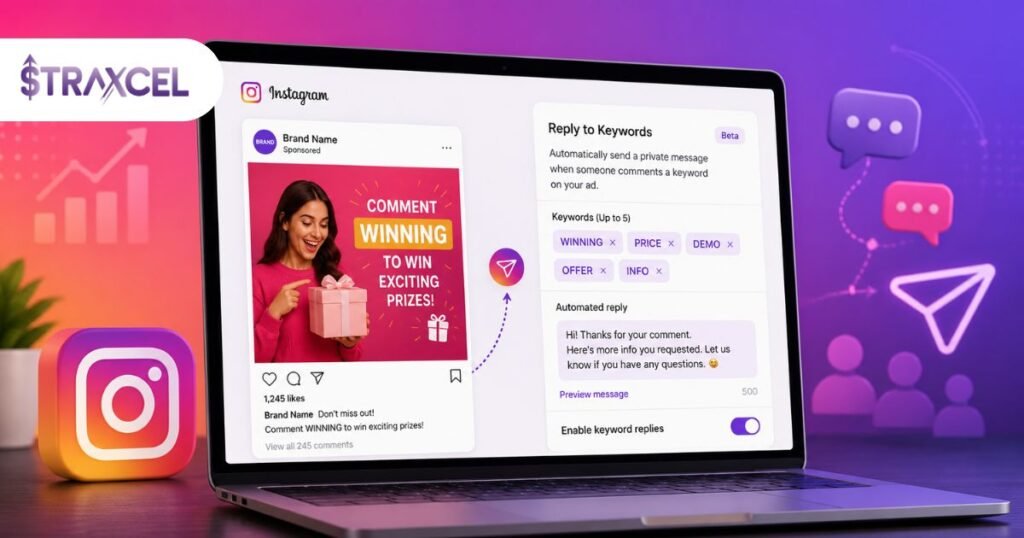
Meta Testing Keyword-Triggered Auto-DMs on Instagram Ads Meta is testing a new feature called Reply to Keywords, now appearing in Instagram ad setup tools for some advertisers. It lets brands pick up to five keywords, and whenever someone comments one of those keywords on a promoted post, Instagram automatically sends them a private DM. The idea is simple : an ad could say “comment WINNING for more info,” and instead of a team member manually replying to every comment, Instagram’s system sends the follow-up DM automatically. It’s built to speed up lead nurturing directly from ad comments, without any manual work on the advertiser’s side. A version of this already exists through Meta’s inbox automation and Business Agent tools, but this ties the same functionality directly into Instagram’s ad setup, making it easier to trigger from a single promoted post. For now, it’s only showing up for Instagram ads, not Facebook. What This Means For Advertisers in India This is a low-effort way to turn ad comments into a direct lead-nurturing channel without adding manual work for your team. If you’re running Instagram ad campaigns, it’s worth testing keyword-based CTAs like “comment for pricing” or “comment DEMO,” since a warm DM follow-up often converts better than someone having to leave the app to fill out a form. Worth noting: this is still a limited test, so availability may vary by account, and there’s no confirmed wider rollout date yet. Clients Also Ask Will this replace the need for a team member to manage DMs? Not entirely. This handles the first response well, but any real conversation past that initial keyword-triggered DM still needs a person or a more advanced automation tool to carry it forward. Think of it as a fast first touch, not a full replacement for follow-up. Is this actually useful, or just a gimmick? It’s genuinely useful for one specific job : reducing the lag between someone showing interest in a comment and getting a response. In my experience, response speed on social media directly affects conversion, so even this simple a feature can meaningfully improve lead quality if you’re getting decent comment volume on your ads already. Should I switch my ad CTAs to use this now? If you’re already running Instagram ads and have access to the test, it’s worth trying on one campaign before rolling it out everywhere. Test a clear, simple keyword against your current CTA and compare DM response rates and follow-through, rather than assuming it’ll automatically outperform what you’re doing now. Why is this only on Instagram and not Facebook ads yet? Meta has been pushing DMs as a growing channel for consumer-to-business interaction for a while now, and Instagram tends to get these conversational features first since DM usage skews heavier there. It’s reasonable to expect this to expand to Facebook ads eventually if the test performs well, but there’s no confirmed timeline yet. Does this fit into a bigger trend worth watching? Yes. Meta’s been steadily investing in DM-based business tools as messaging becomes a bigger part of how people interact with brands online. Advertisers who get comfortable building keyword-triggered and automated DM flows now will likely have an easier time adapting as Meta rolls out more advanced conversational ad tools down the line. Recommended For You Meta Testing Keyword-Triggered Auto-DMs on Instagram Ads Learn more Semrush vs Ahrefs : Which SEO Tool Should You Actually Buy Semrush vs Ahrefs : Which SEO Tool Should You Actually Buy Every few weeks, a… Learn more Top Digital Marketing Trends To Excel Your Business in India Top Digital Marketing Trends To Excel Your Business in India A client of mine, someone… Learn more Author Profile STRAXCEL blogs are written by Mr. Subham Sarkar, who has extensive level of experience and expertise and helped 100+ startups to excel their revenue. Post Categories 360 Digital Marketing Business Development Expert Answers Clients Results Founder Insights Service Guides AI Tools Industry Insights What We Offer Full-stack Website Development Search Engine Optimization Generative Engine Optimization Social Media Management Mobile App Development Performance Marketing Content Creation Latest Updates Full-stack Website Development Search Engine Optimization Generative Engine Optimization Social Media Management Mobile App Development Content Creation Joke of the Day Performance marketers don’t sleep, they just refresh the dashboard every 4 hours and call it self-care.
Meta Removes Option to Exclude Ad Placements (Straxcel Business Solutions)
META, Social Media Updates

Meta Removes Option to Exclude Ad Placements

Meta Removes Option to Exclude Ad Placements Meta is rolling out a change that removes the Placements option from ad sets, meaning advertisers will soon lose the ability to exclude specific placements from their campaigns. Until now, if you didn’t want your ad showing up in Facebook search results or in Reels, you could opt out of that placement directly. That control is going away. It doesn’t stop at placements either. Meta is also removing the option to exclude specific apps from a campaign. Going forward, its automated system will decide where each ad performs best, whether that’s Facebook, Instagram, or elsewhere across its apps, without the advertiser choosing. No official rollout date has been confirmed yet, but some advertisers are already being notified of the change. Why This is Happening This fits into Meta’s larger push toward fully automated ad campaigns. The long-term goal, as Meta’s CEO has described it, is a system where a business simply connects its objective and payment details, and Meta’s AI handles creative, targeting, and placement entirely on its own. Removing manual placement controls is one more step in that direction, shifting decision-making away from advertisers and fully into Meta’s automated system. What This Means For Meta Advertisers If you’re running Meta ads for your brand, this is worth watching closely. Less manual control means you’ll need to trust Meta’s algorithm to place your ads well, rather than steering that decision yourself. For brands that have deliberately kept ads out of certain placements, such as avoiding in-stream Reels ads or search placements for brand reasons, that flexibility may soon disappear. The upside, if Meta’s automation performs as promised, could be stronger overall results with less manual work. The risk is losing the fine-grained control that some performance marketing strategies depend on. Either way, it’s a good time to review your current placement settings and prepare for a shift toward a more automated setup. Clients Also Ask Will my current campaigns be affected immediately? No official rollout date has been confirmed yet, so existing campaigns should keep running as they are for now. That said, once the change lands, any placement exclusions you’ve set up manually will stop applying, so it’s worth documenting your current setup now in case you need to rebuild targeting logic elsewhere later. Can I still avoid placements I know don’t work for my brand, like Reels or Audience Network? Not directly once this rolls out. In my experience, this is the change that’ll sting most for brands that avoided certain placements for legitimate reasons, not just performance, but brand safety, like keeping ads off content types that don’t match their tone. Without exclusion controls, that safeguard disappears, and the only real workaround is closely monitoring where your ads actually run and adjusting creative to work across more contexts. Does this mean Meta’s automated placement will perform better than my manual choices? Sometimes, yes. Meta’s system has access to performance data at a scale no single advertiser can match, and broader placement testing often does surface cheaper, better-converting inventory you wouldn’t have found manually. But “better on average” isn’t the same as “better for every brand,” and businesses with narrow, specific audiences or strict brand guidelines may see this as a net loss of control, not a gain in performance. Should I pause or restructure my campaigns ahead of this change? I wouldn’t recommend pausing anything yet, since there’s no confirmed date. What’s worth doing now is reviewing why you excluded certain placements in the first place. If it was purely a performance call, automation may actually improve results. If it was a brand safety or messaging call, start preparing creative variations that can hold up across a wider range of placements, because that flexibility will matter more once manual exclusion is gone. Is this part of a bigger shift advertisers should be preparing for? Yes, and this is the part worth paying real attention to. This sits inside Meta’s broader move toward fully automated campaigns, where creative, targeting, and placement are eventually all handled by its AI with minimal advertiser input. The practical takeaway for brands is to get comfortable feeding Meta’s system strong creative variety and clean conversion data now, since that’s likely to become the main lever advertisers have left as manual controls keep getting phased out. Recommended For You Meta Removes Option to Exclude Ad Placements Meta Removes Option to Exclude Ad Placements Meta is rolling out a change that removes… Learn more How Does Google Ads Bidding Actually Work? How Does Google Ads Bidding Actually Work? The first time I explained Google Ads bidding… Learn more What Is Local SEO and Why It Is a Must For Local Businesses in 2026 and Beyond What Is Local SEO and Why It Is a Must For Local Businesses A dental… Learn more Author Profile STRAXCEL blogs are written by Mr. Subham Sarkar, who has extensive level of experience and expertise and helped 100+ startups to excel their revenue. Post Categories 360 Digital Marketing Business Development Expert Answers Clients Results Founder Insights Service Guides AI Tools Industry Insights What We Offer Full-stack Website Development Search Engine Optimization Generative Engine Optimization Social Media Management Mobile App Development Performance Marketing Content Creation Latest Updates Full-stack Website Development Search Engine Optimization Generative Engine Optimization Social Media Management Mobile App Development Content Creation